REVIEW
We invited EDWARD SANDERSON to write a review for Sonic Anchor 48: On that note.
Dr Edward Sanderson, is a researcher, curator, and archivist of contemporary non-mainstream sound culture in Mainland China and Hong Kong. In 2023 they co-curated Sounds Like Print at Tai Kwun Contemporary, and in 2025 curated the major museum exhibition, It Always Sounds Somewhere: Sounding Sound Practice in Chinese Mainland and Hong Kong Since the 1990s at Beijing’s Inside-Out Art Museum. They currently live and work in London, UK.
Making Community in Provisional Spaces
Since 2012 Contemporary Musiking Hong Kong (CMHK) have regularly held their Sonic Anchor events in the McAulay Studio, found in the basement of the Hong Kong Arts Centre (HKAC) building. Sonic Anchor #48, which took place in October 2025, was the final event using this location. This text begins with some comments about Sonic Anchor and this latest iteration, and then becomes a meditation on how the sound practices experienced in Sonic Anchor could conceivably be said to generate community through their spatial and social aspects.
Yet again, I am grateful for my minor case of OCD that means I can look back over my extensive archive of photographs and see that I have been to eleven editions of Sonic Anchor since my first in 2021. Those visits have been marked by an incredible diversity of practices, as well as the consistency of its location – the McAulay Studio in HKAC. If Sonic Anchor has an identity, then it is in its use of sound as an instigator of social relations aided by a specific space.
In those performances over the years, I have noticed that the works themselves often create their social relations by laying out before the audience real-time experiments with sound rather than polished, finished works. The performances tend to work outside of narrative structures that might be characterized as having a clear sense of progression. Instead, the artists offer focused experiences of aspects of their practice. This is not always the case, and some performances set up situations in front of the audience which then play out in some way, possibly with some kind of denouement to complete the piece. But even in this more traditional narrativity, progress is marked by a freeness in exposition, leaving plenty of room for improvisation.

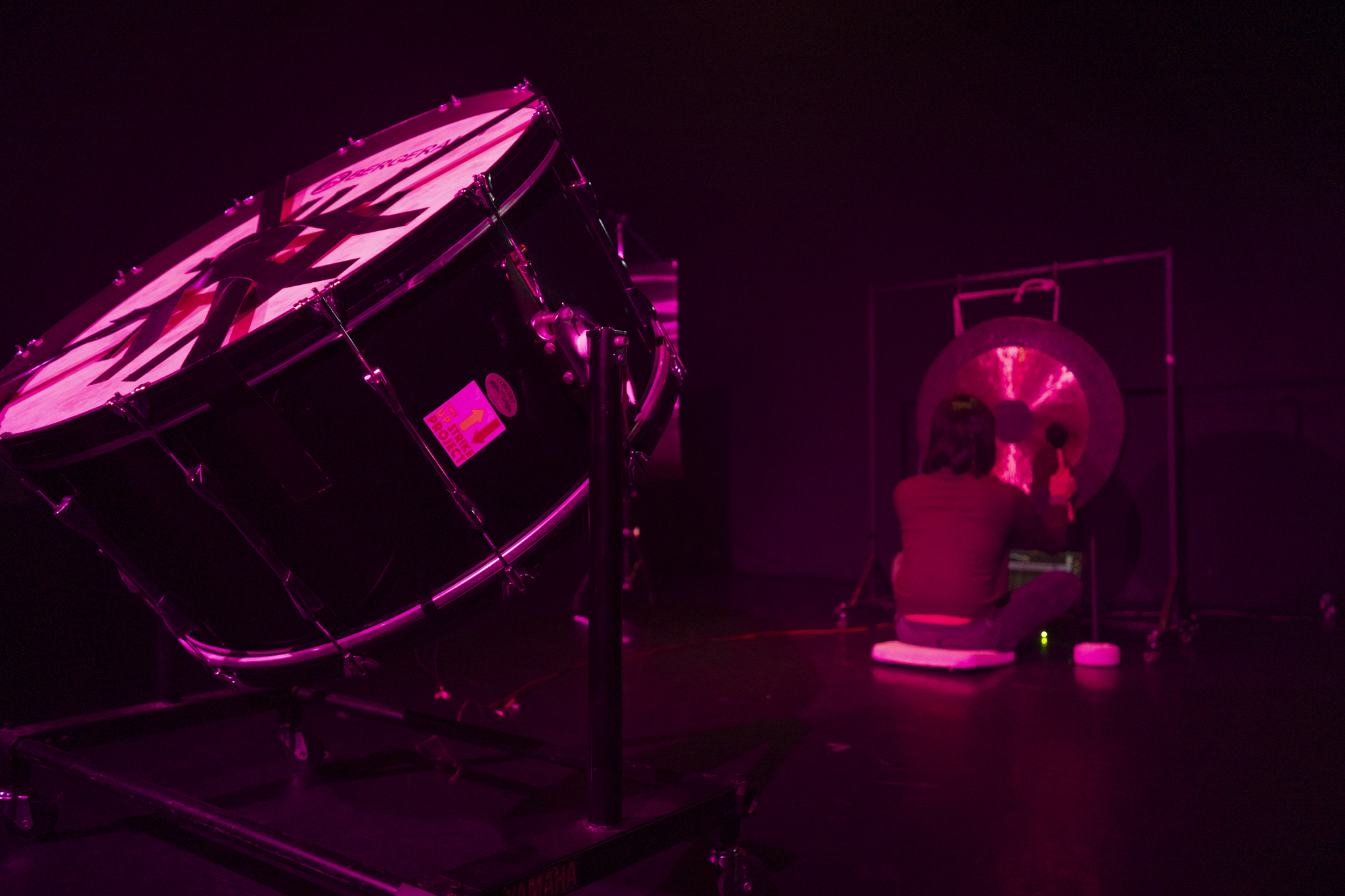
This was certainly evident at the most recent Sonic Anchor in October. For the first performance, the stage was bathed in red lighting, with artist Peter Yu sitting cross-legged in front of a large metal gong. Placed between him and the audience was a large bass drum raised up on a stand, with two sheets of metal hanging from frames on either side of him.
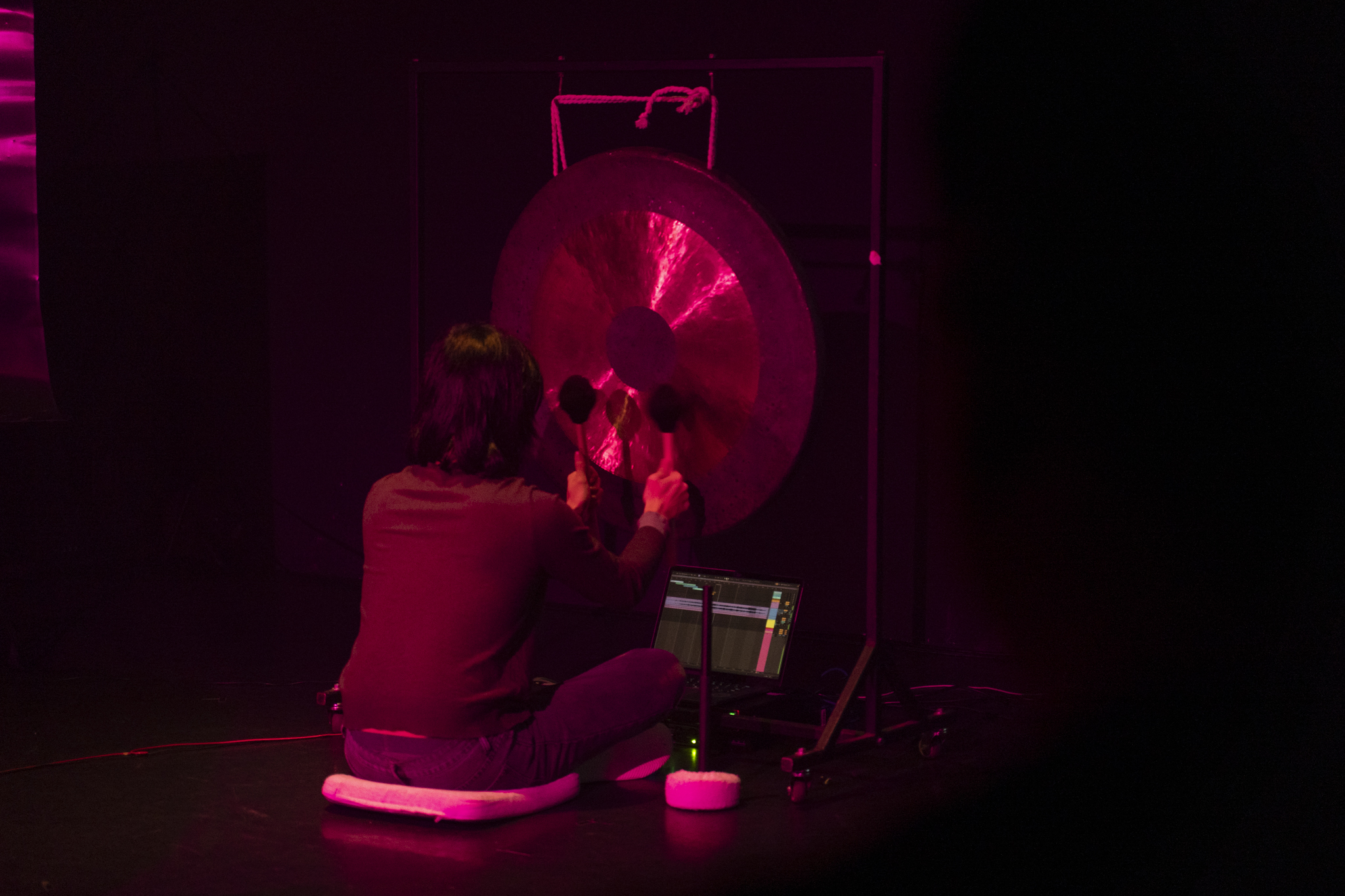
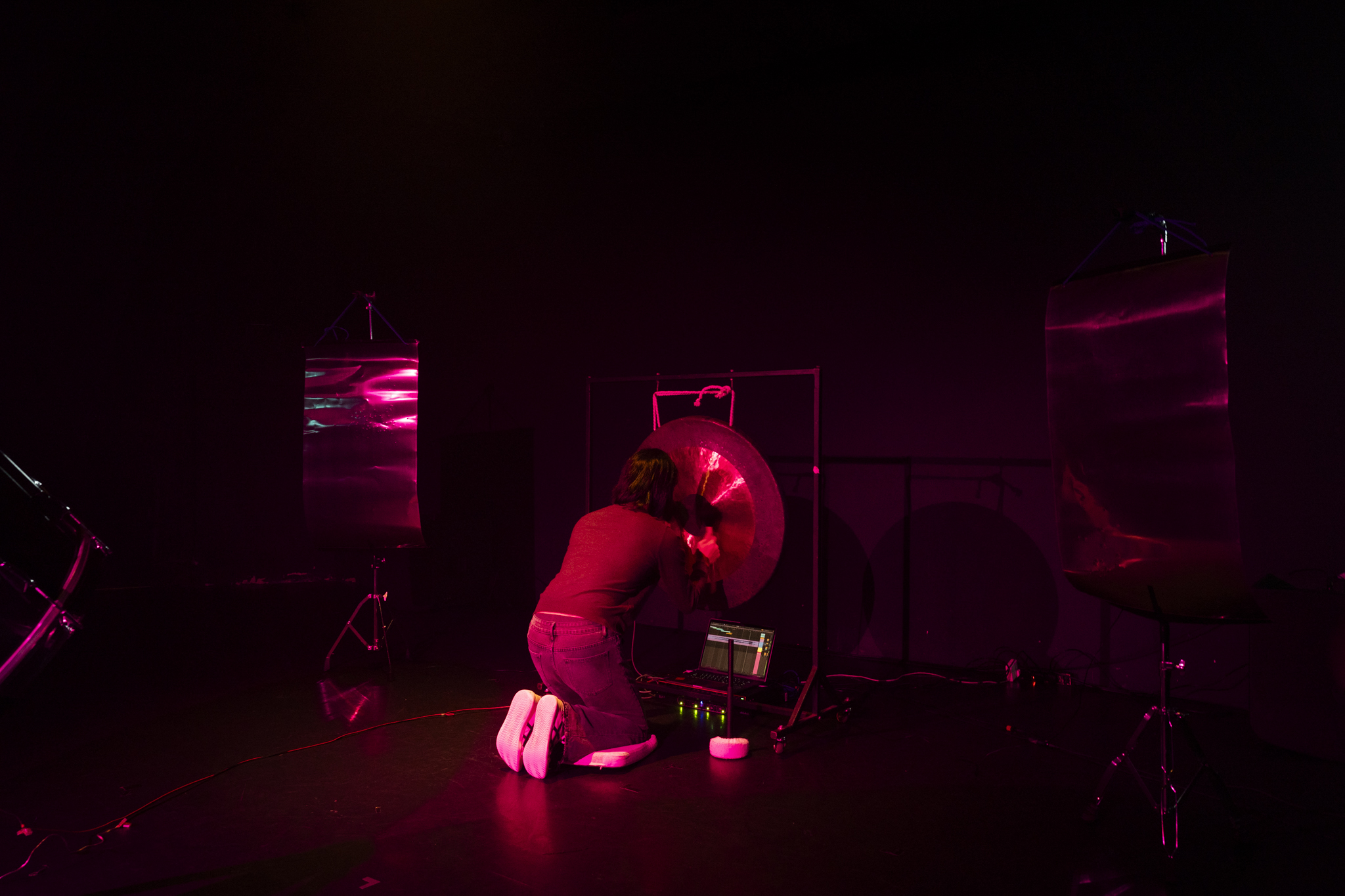
Peter progressed to beat the gong, building up a rhythm, while the large drum had a resonator taped to its skin linked to the artist’s laptop, which also had a contact microphone input from the gong, so perhaps was being driven by its beating.
However it was comprised, the overall combination of percussive sounds developed a palpable vibration throughout the room, which seemed to be sympathetically vibrating the hanging metal sheets. It also vibrated the insides of my body, a visceral experience I imagine was shared with the other bodies in the room. The sounds were not just pressure waves that hit our skin and ear drums, but also a feeling experienced within the body as its materials vibrated in tandem, transferring from Peter to everybody across the space of the room.
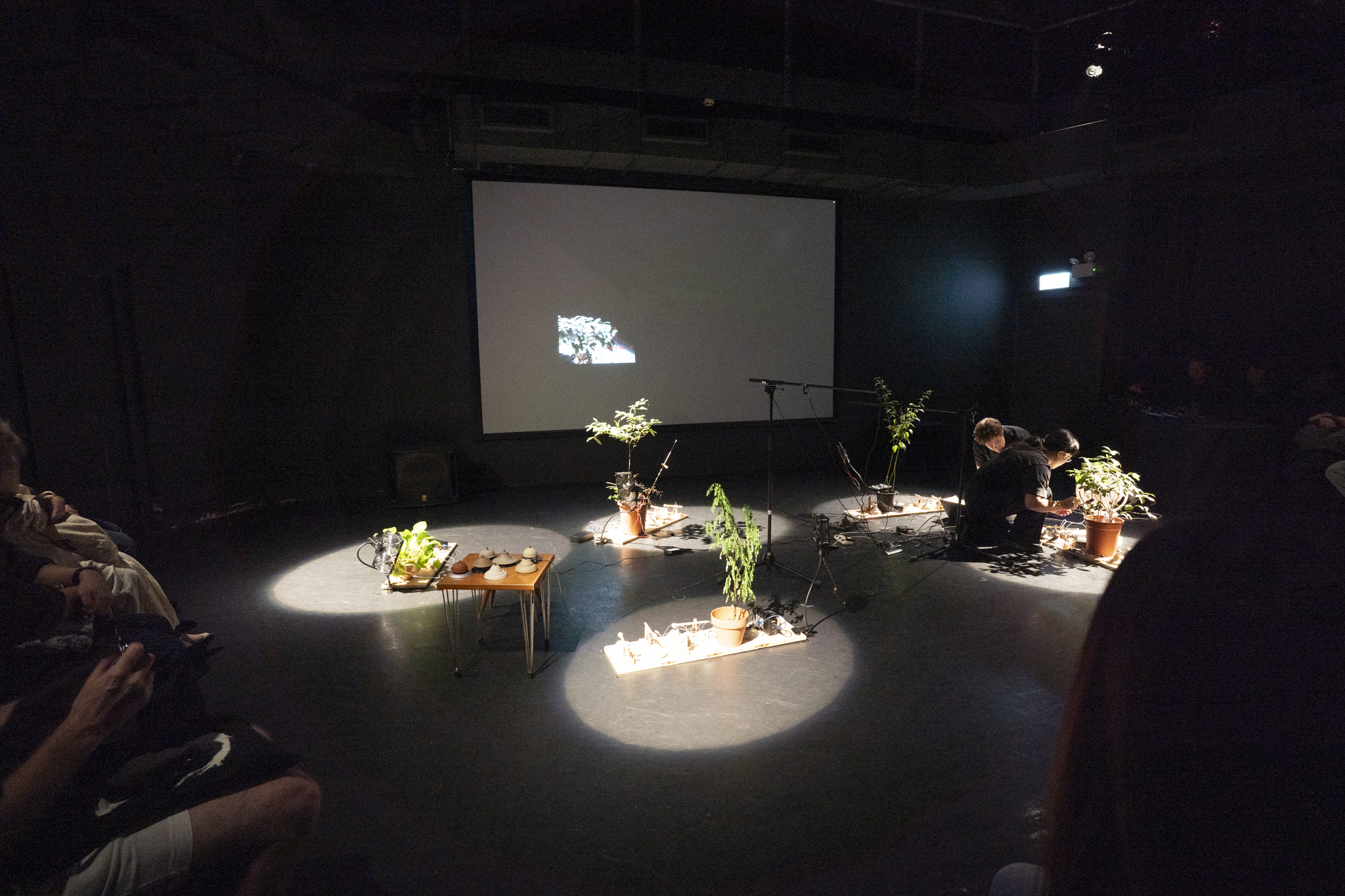
During a short break, groups of pot plants, electric fans, and various ceramic bowl-like objects with metal projections at their apex had been distributed around the stage area for Cheri Tang and Dmitry Po’s performance. Some bowls had mechanical arrangements of pivoting sticks controlled by electronic systems which intermittently tap-tap-tapped the bowls, creating uneven and unpredictable chime-like sounds.
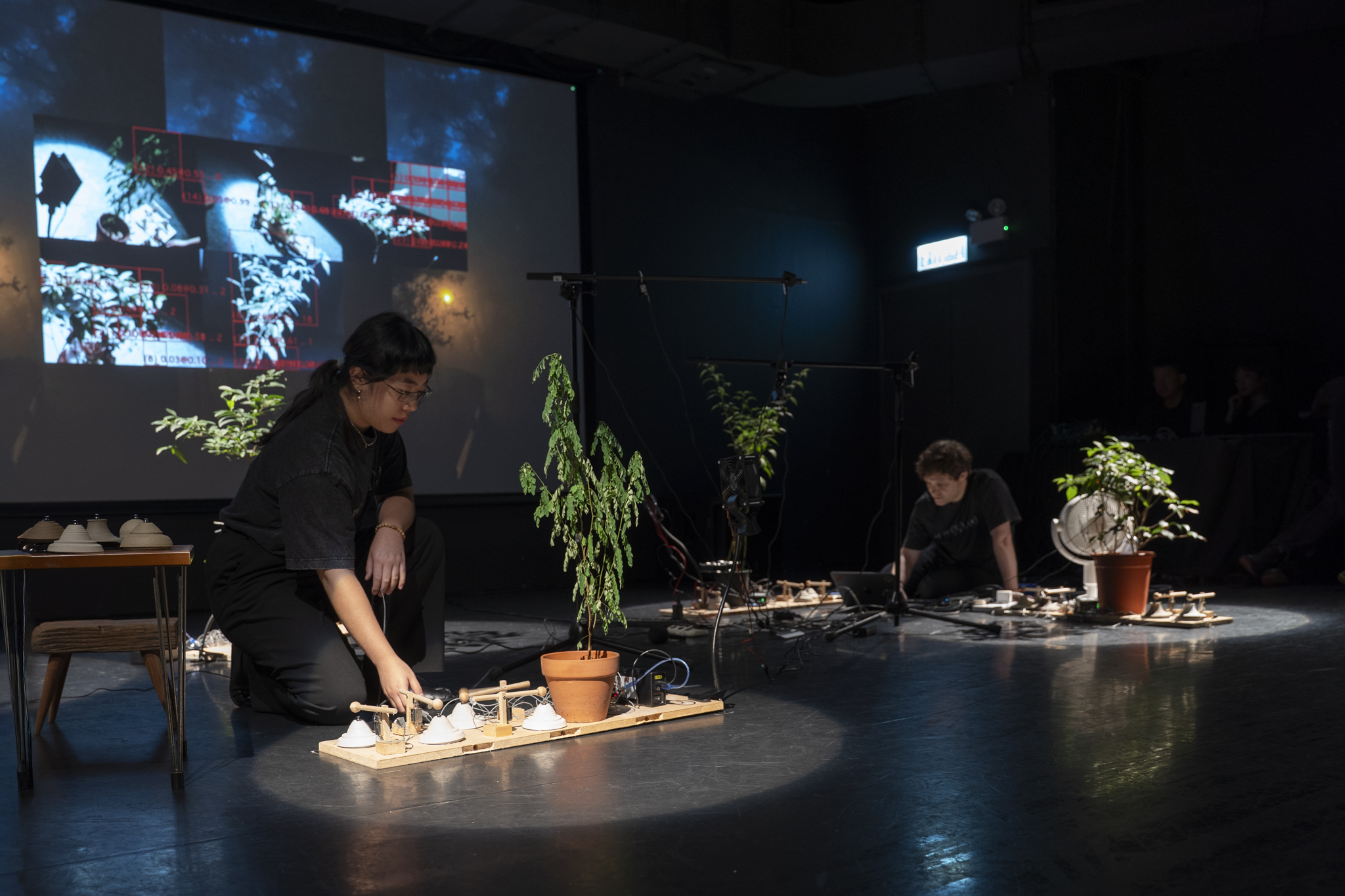
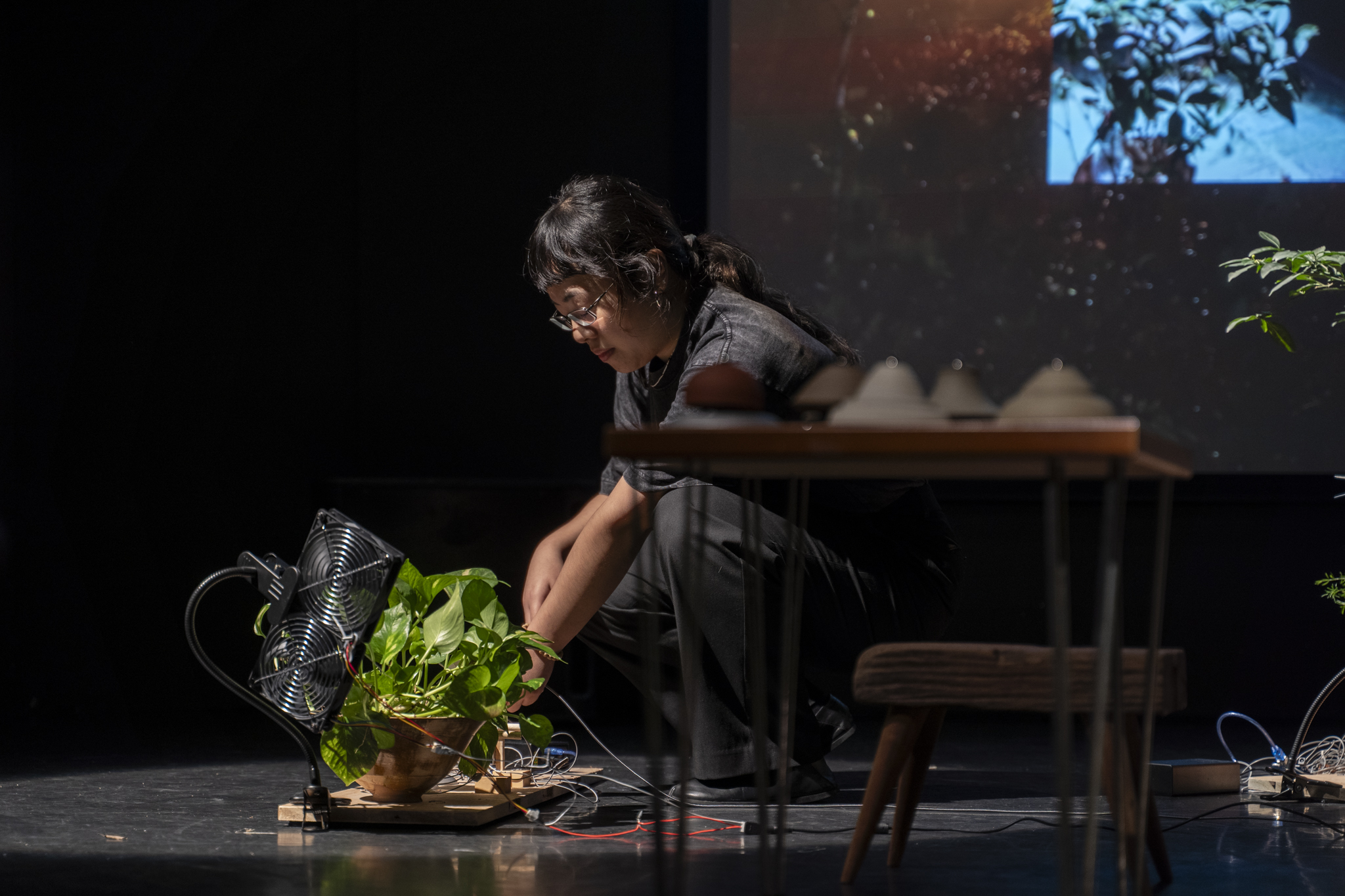
Cheri moved between each group and switched on the fans, which in each case led to a renewed flurry of tapping from the sticks. It became evident that the plants were also performers as they had sensors attached to them which were reacting to the breeze and producing the impulses to trigger the tapping sticks. In some cases, the plants were left to tap out their messages unassisted, but sometimes the artists interacted with them to affect the chimes being produced.
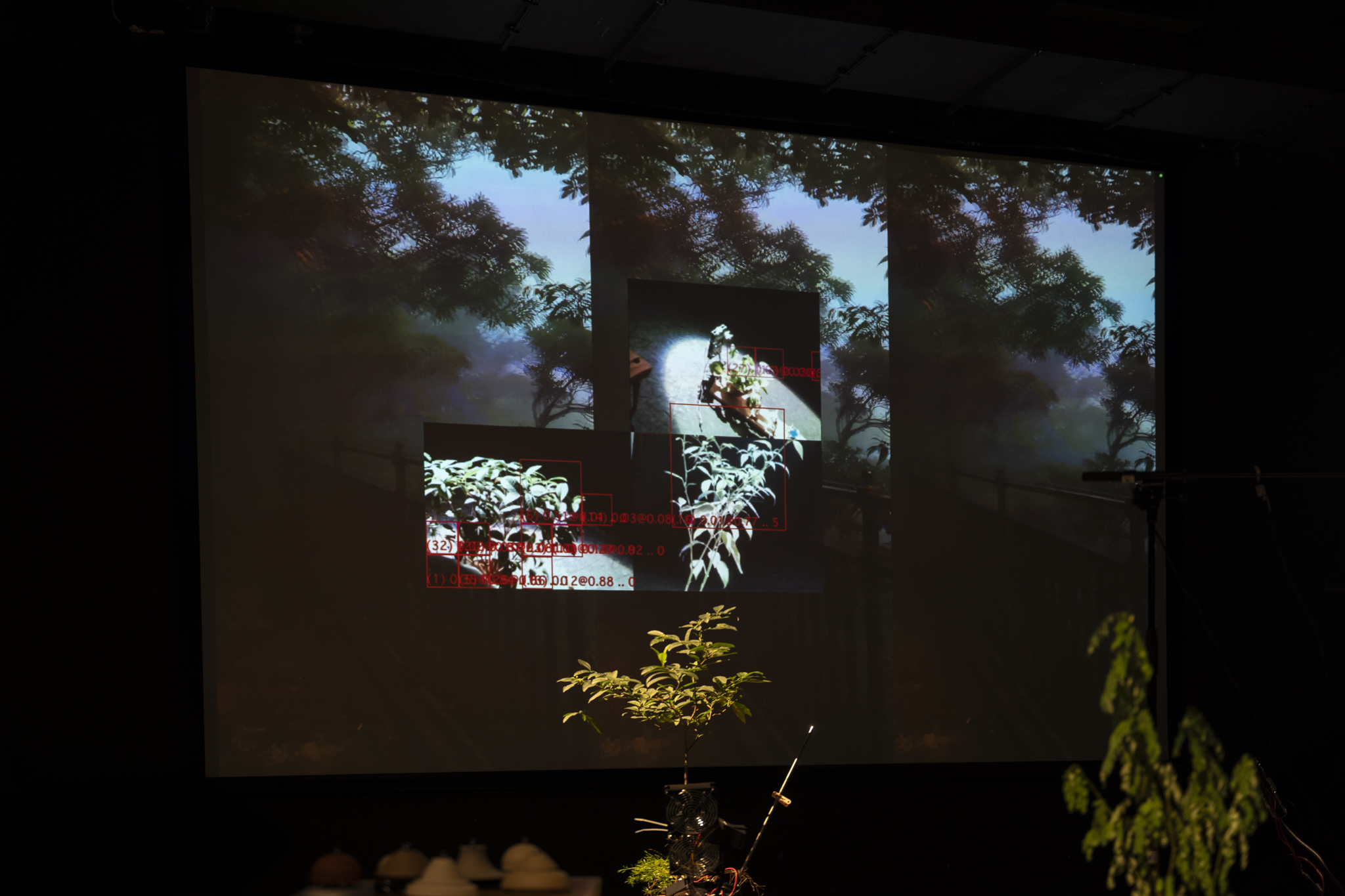
Behind them a projection showed live video feeds of each plant activated by their movements, and over which colored boxes intermittently appeared mirroring those of facial recognition software – another indication that the plants were being treated as sentient participants in the performance.
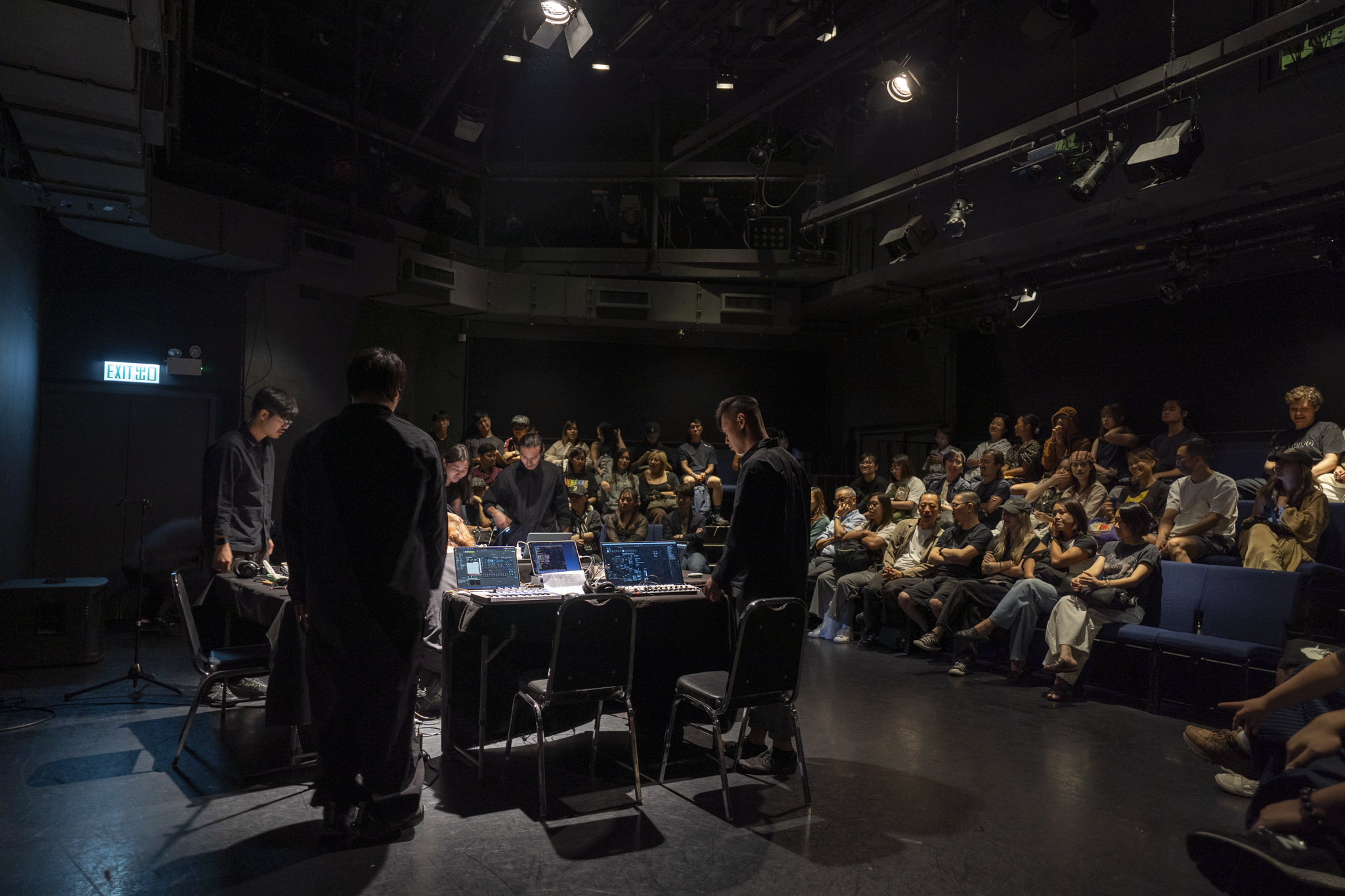
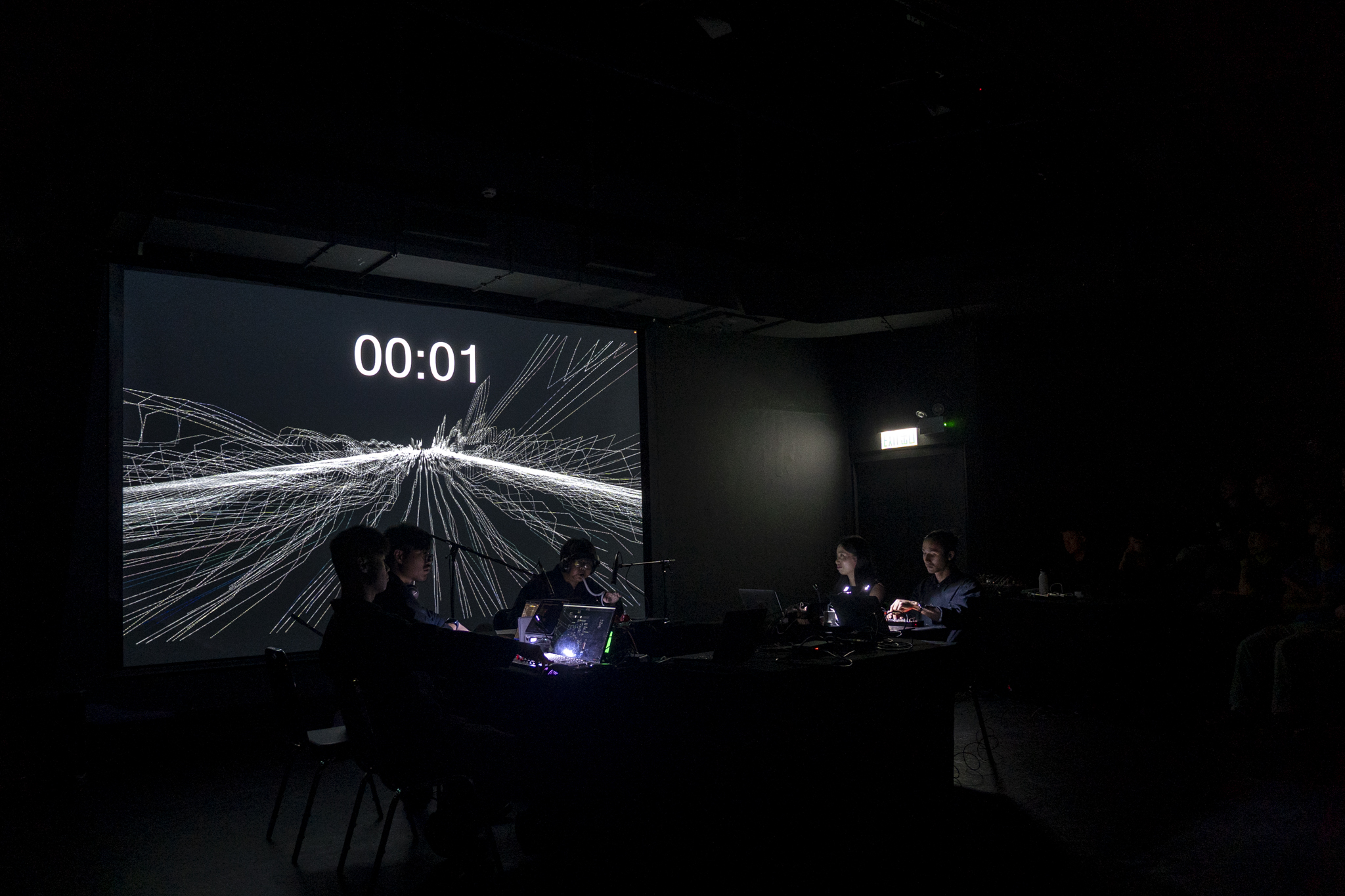
After the plants had left the stage, the next group of artists arranged four tables in a square. The five members of the group (Andy Kwan, space_bar_presser, Tina Yeung, Timothy Choi, and Preston Lui) sat around these tables with various laptops and electronic instruments controlling the sound and visuals.
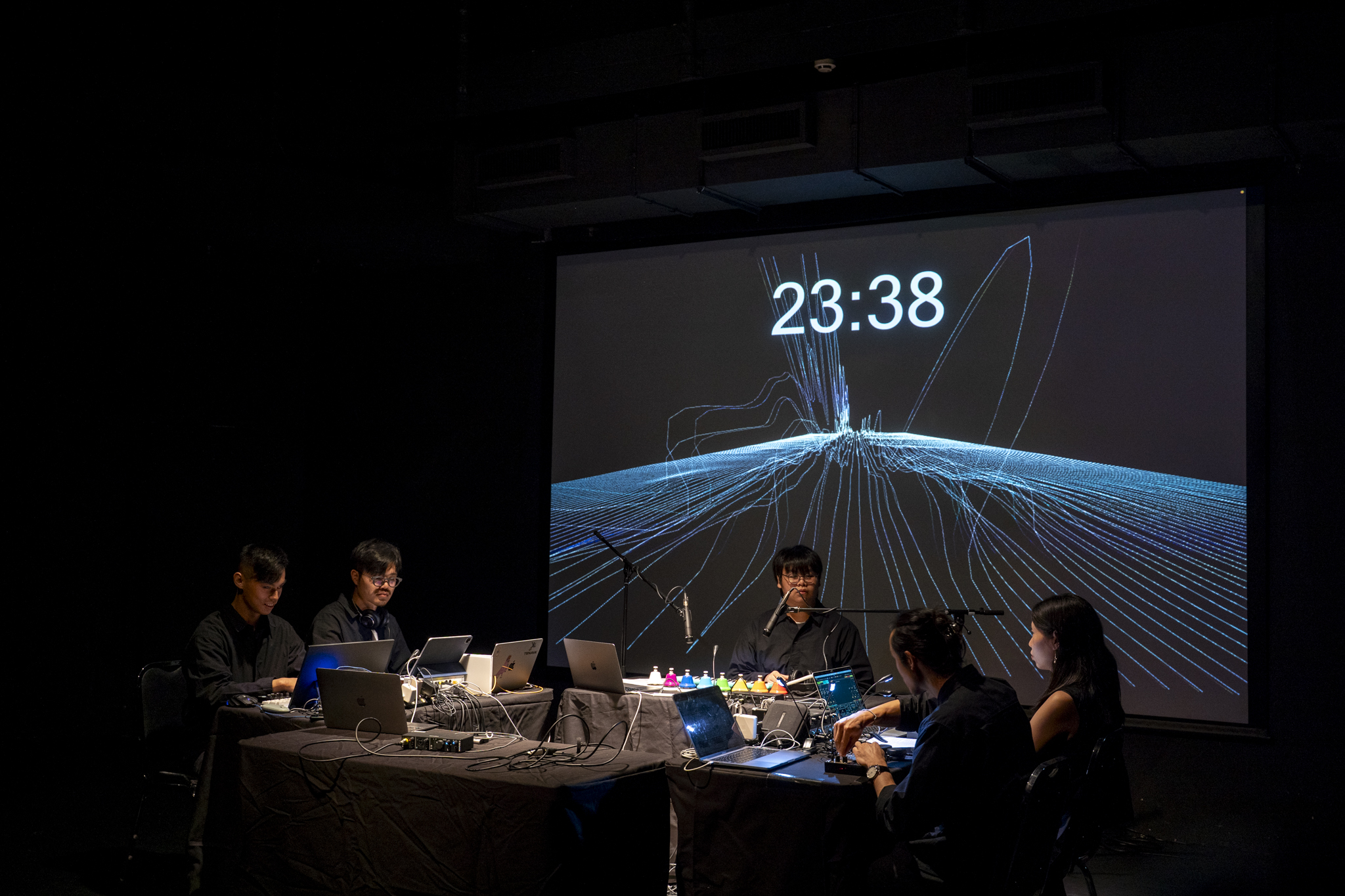
Behind them was projected a generative video the group programmed, showing a schematic single-point perspective view of a series of thin lines representing a flat surface which the viewer appeared to be flying over. The intensities of the sounds played by the artists were translated into the vertical heights of these lines, with low frequencies towards the left and high frequencies to the right. A digital clock floated above these lines, counting down from 25:00 (minutes) to zero, at which point the performances ended. Although I could not work out the system, there appeared to be timed sequences, but within this structure the artists seemed to be free to improvise.
I appreciated the intentions and expositions of all these performances, and I was certainly engaged by the experience of trying to understand what was happening. Following the event I had some thoughts.

I felt Peter Yu’s performances could have been expanded to work with the space more, perhaps by breaking down the static arrangement of the artist, their instruments, and the audience. If the audience could move around while the drums were being beaten, the various locations where the sound waves created intensities (or not) could be physically experienced in real time.
For Cheri and Dmitry’s (and the plants’) performance, I wondered whether the conversation facilitated by the tapping sounds could be developed between the artists and plants – and as with Peter’s piece, could the audience be involved somehow? I feel the most meaningful aspect of the final performance was the interaction between the artists.
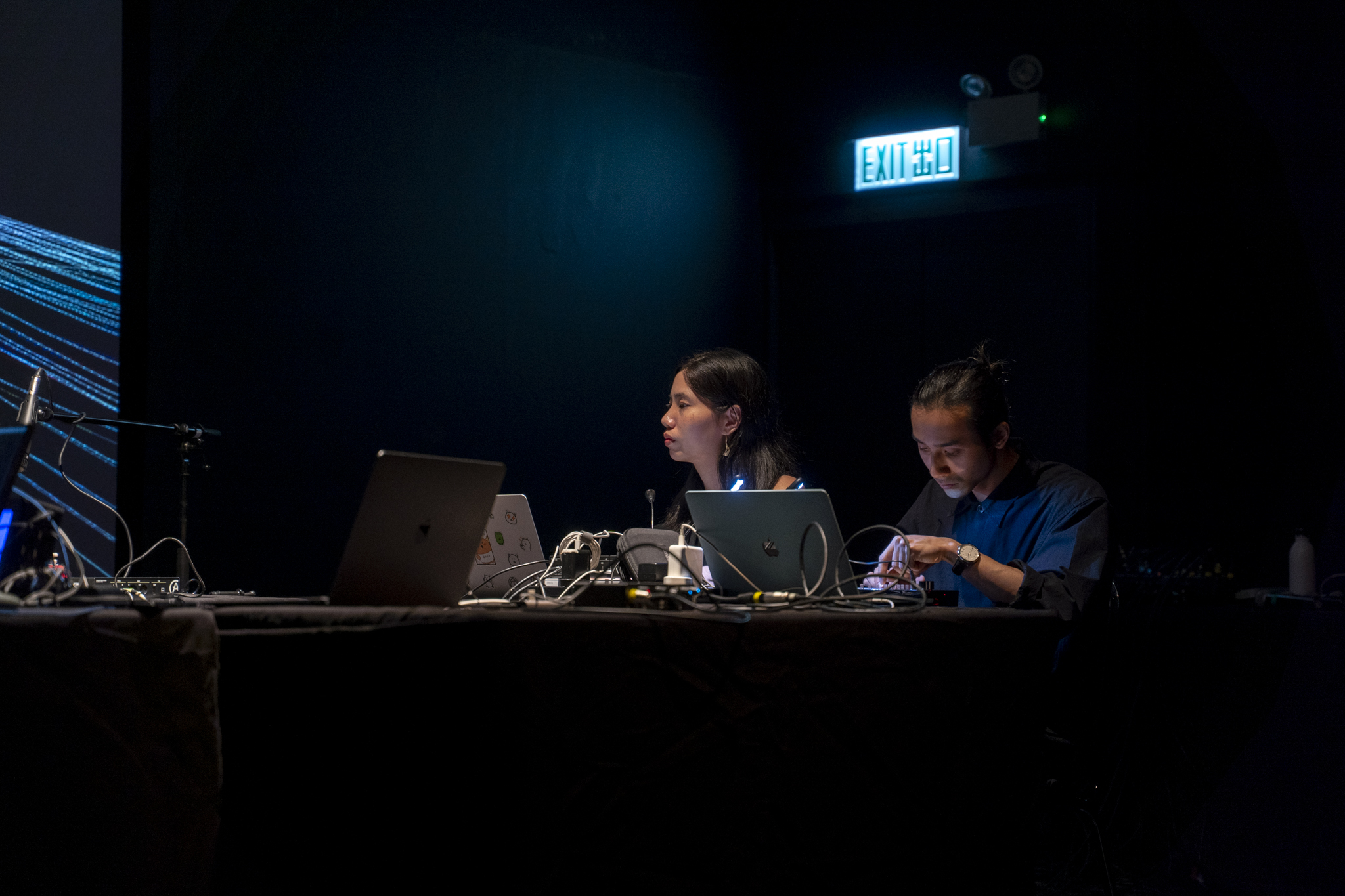
This was particularly evident when the final group were sharing glances across the tables to coordinate their progress through the various sequences of their composition, I felt a sympathetic response with their task. But I would have liked to focus on this aspect, but I found the projection a distraction.
The countdown in particular created an uncomfortable awareness of time remaining, preventing me from getting lost in the artists’ activities. Such visualizations might be technically interesting, but I was not convinced they provided additional insights into the performance.
Looking and listening back over all the Sonic Anchors I have been to, I appreciate that I have found most interest in these interactions with the space – a realization that will come as no surprise to anyone familiar with my own research into the spaces for sound practices. For that reason, I am interested in discussing the wider socio-geographical context for Sonic Anchor.
HKAC is a well-known institution in Hong Kong, providing various kinds of business and performance spaces for cultural organizations. The building housing HKAC sits near the waterfront of Hong Kong Island’s Wan Chai district, in a heavily developed section of the city where official, educational, and cultural institutions have their offices. The building itself occupies a relatively small plot of land, but extends upwards for 16 floors, a typical response to Hong Kong’s precious real estate which encourages development vertically rather than horizontally.
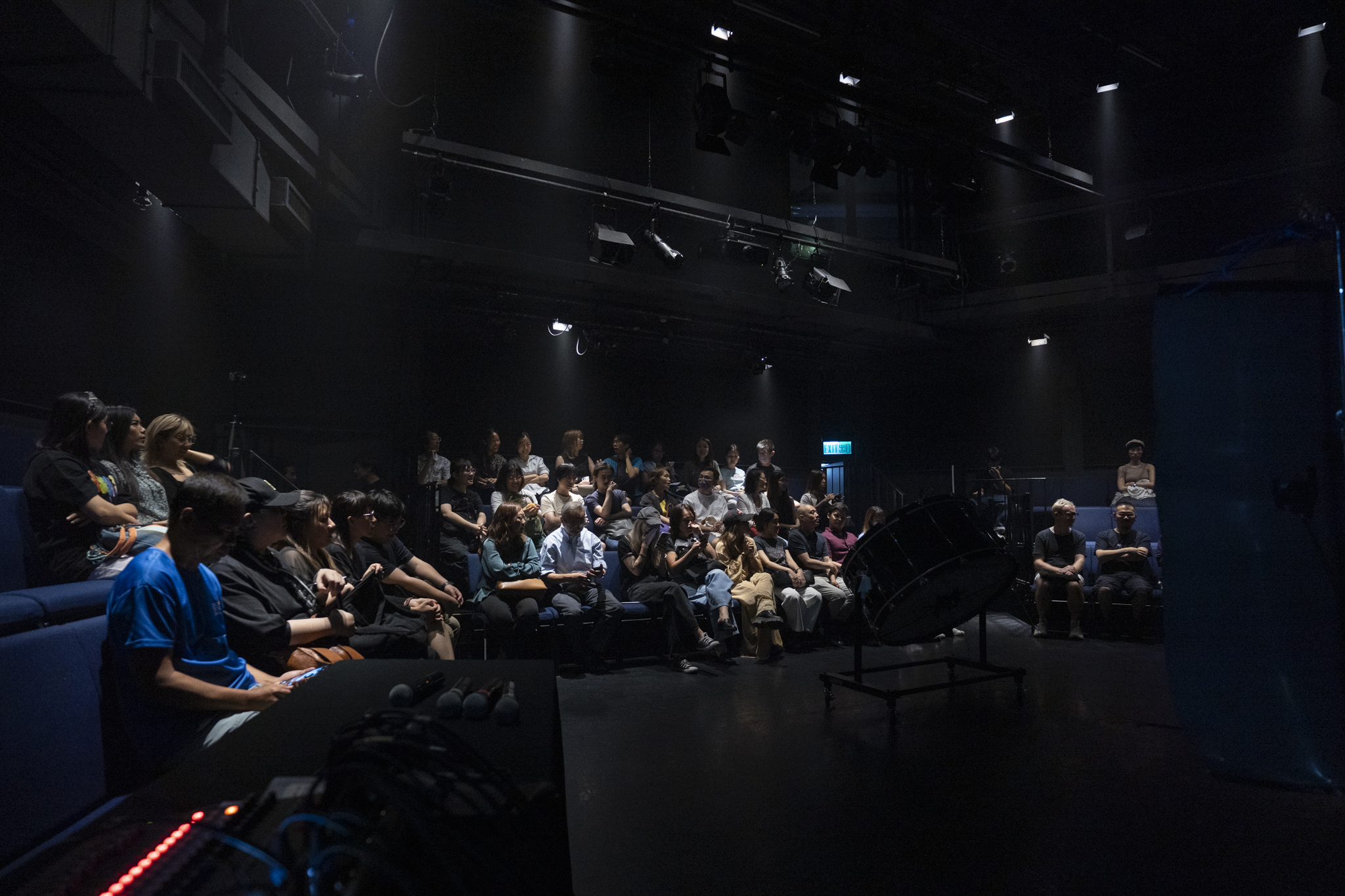
The McAulay Studio is a black-box theatre space, and it usually follows the arrangement of a traditional theatre, with the performers occupying center-front stage and the audience seated in a horseshoe around three sides of the stage area. My feeling is that this traditional seating arrangement discourages interaction between the artist and audience – the performance takes place in a special, distinct space, literally and figuratively separated from the audience—this is not an original observation, indeed might be said to be the point of such an architectural arrangement. Entering and taking one’s seat marks the crossing of a threshold between our everyday world and the world of the theatrical presentation, an imaginary space where anything can be represented, and to which we are transported given we suspend our disbelief. However, while it is certainly a space capable of such theatrical presentations, the unadorned construction of the McAulay Studio (exposed infrastructure; seats supported by bare scaffolding; entirely painted in black) means that it does not adopt the full gamut of forms of staging that a theatre would involve and such suspension of disbelief is more difficult without additional stage dressings. Indeed, the name “Studio” distinguishes it from a regular “Theatre” and suggests less formality in the stagings that occur there. This is most evident in the lack of a raised stage area – although the audience sits on the raked banks of seats, the front row is at the same level as the performance area. For Sonic Anchor I would always sit in the front row to be as close as possible to the action. This choice to sit in the front row was to ensure a good view and allows me to have a closer engagement with the performance. Sometimes this leads to instances where a performance involves interaction, which may be uncomfortable for me, but nevertheless that is usually a valuable part of the experience and a piece’s meaning. In these situations, the stage expands to include the audience – or the real world and the performance on stage take on aspects of each other.
This “reality” also seems to be reflected in the style of work that Sonic Anchor often presents. In them it feels that the imaginary tends to be held at bay, and the presentations often have a prosaic character – they demonstrate rather than conceal. They eschew elaborate stage settings and favor the artists’ direct engagement with the space they share with the audience. The performances focus on what is in front of the audience—the artists, their actions, and the sounds being produced—with little overt interpretation and usually avoiding scenery and mise-en-scène. In some cases, the artists act out narratives above and beyond those which the items on stage embody, but usually their actions are directly related to the equipment they are manipulating and the meaning that came directly from them.
I find such engagement interesting and meaningful because I see a connection between engagement through sound practices and the real-world development of community in spaces. As a space the McAulay Studio sits in an interesting buffer zone between generic, institutional places and spaces that bear the potential to become identified with a community. As a rented space, the Studio can only be used for short periods of time by a organization. The Studio space is designed to be as adaptable and nonspecific as possible, and must be returned to its generic appearance after every event. On the one hand this adaptability is a luxury allowing predictability, flexibility, and high levels of potentiality for the productions taking place inside. On the other hand, it strips out the distinctiveness of a space which could connect the users with it – a distinctiveness which could inform the meaning of the organizers’ activities, represent their distinct way of thinking and working, and become a hub around which community could form. I feel this limitation should also work against the time necessary for the formation of a community identity. Longer-term occupation of a space allows the occupants to make it their own, establishing a public sense of connection between the occupants and the space. The distinctiveness of a space becomes part of the meaning of the activities that take place inside, and is one aspect by which communities can be identified.
Although the short-term availability of the McAulay Studio means that it cannot so easily become associated with a particular organization, group, or community, CMHK have nevertheless been using McAulay studio for so long that they have developed an association, if not a connection, to it. This manifests itself for me in the fact that I have been to so many events organized by CMHK there that when entering the building there is a sense of familiarity in that specific space that I associate with CMHK and Sonic Anchor.
But change is a constant, every space has a lifespan, and now CMHK’s time in the McAulay Studio is at an end. I understand they are now taking this opportunity to end the Sonic Anchor series in part because it had developed this association with the McAulay Studio, demonstrating the real-world connections established between events and spaces. It is encouraging that even in the shared and somewhat institutional venues that are relatively common in Hong Kong, identity and community can emerge although their fragility is a constant concern. In this case they form because of the sound practices that take place in space, and these sounds have therefore played a role in defining what space can mean in the cultural environment here.
Review by Edward Sanderson
Photos by Helen Leung
//
Sonic anchor #48 - On That Note
Artists: Pete Yu, Dmitry Po, Cheri Tang , Andy Kwan, @space_bar_presser, Tina Yeung, Timothy Choi and Preston Lui
Curator: Karen Yu
Co-presentation by: Contemporary Musiking Hong Kong and Hong Kong Arts Centre
Supported by: Hong Kong Arts Development Council
香港藝術發展局支持藝術表達自由,本計劃內容並不反映本局意見
Hong Kong Arts Development Council supports freedom of artistic expression. The views and opinions expressed in this project do not represent the stand of the Council.
REVIEW
We invited EDWARD SANDERSON to write a review for Sonic Anchor 48: On that note.
Dr Edward Sanderson, is a researcher, curator, and archivist of contemporary non-mainstream sound culture in Mainland China and Hong Kong. In 2023 they co-curated Sounds Like Print at Tai Kwun Contemporary, and in 2025 curated the major museum exhibition, It Always Sounds Somewhere: Sounding Sound Practice in Chinese Mainland and Hong Kong Since the 1990s at Beijing’s Inside-Out Art Museum. They currently live and work in London, UK.
Making Community in Provisional Spaces
Since 2012 Contemporary Musiking Hong Kong (CMHK) have regularly held their Sonic Anchor events in the McAulay Studio, found in the basement of the Hong Kong Arts Centre (HKAC) building. Sonic Anchor #48, which took place in October 2025, was the final event using this location. This text begins with some comments about Sonic Anchor and this latest iteration, and then becomes a meditation on how the sound practices experienced in Sonic Anchor could conceivably be said to generate community through their spatial and social aspects.
Yet again, I am grateful for my minor case of OCD that means I can look back over my extensive archive of photographs and see that I have been to eleven editions of Sonic Anchor since my first in 2021. Those visits have been marked by an incredible diversity of practices, as well as the consistency of its location – the McAulay Studio in HKAC. If Sonic Anchor has an identity, then it is in its use of sound as an instigator of social relations aided by a specific space.
In those performances over the years, I have noticed that the works themselves often create their social relations by laying out before the audience real-time experiments with sound rather than polished, finished works. The performances tend to work outside of narrative structures that might be characterized as having a clear sense of progression. Instead, the artists offer focused experiences of aspects of their practice. This is not always the case, and some performances set up situations in front of the audience which then play out in some way, possibly with some kind of denouement to complete the piece. But even in this more traditional narrativity, progress is marked by a freeness in exposition, leaving plenty of room for improvisation.

This was certainly evident at the most recent Sonic Anchor in October. For the first performance, the stage was bathed in red lighting, with artist Peter Yu sitting cross-legged in front of a large metal gong. Placed between him and the audience was a large bass drum raised up on a stand, with two sheets of metal hanging from frames on either side of him.

Peter progressed to beat the gong, building up a rhythm, while the large drum had a resonator taped to its skin linked to the artist’s laptop, which also had a contact microphone input from the gong, so perhaps was being driven by its beating.

However it was comprised, the overall combination of percussive sounds developed a palpable vibration throughout the room, which seemed to be sympathetically vibrating the hanging metal sheets. It also vibrated the insides of my body, a visceral experience I imagine was shared with the other bodies in the room. The sounds were not just pressure waves that hit our skin and ear drums, but also a feeling experienced within the body as its materials vibrated in tandem, transferring from Peter to everybody across the space of the room.

During a short break, groups of pot plants, electric fans, and various ceramic bowl-like objects with metal projections at their apex had been distributed around the stage area for Cheri Tang and Dmitry Po’s performance. Some bowls had mechanical arrangements of pivoting sticks controlled by electronic systems which intermittently tap-tap-tapped the bowls, creating uneven and unpredictable chime-like sounds.

Cheri moved between each group and switched on the fans, which in each case led to a renewed flurry of tapping from the sticks. It became evident that the plants were also performers as they had sensors attached to them which were reacting to the breeze and producing the impulses to trigger the tapping sticks. In some cases, the plants were left to tap out their messages unassisted, but sometimes the artists interacted with them to affect the chimes being produced.

Behind them a projection showed live video feeds of each plant activated by their movements, and over which colored boxes intermittently appeared mirroring those of facial recognition software – another indication that the plants were being treated as sentient participants in the performance.

After the plants had left the stage, the next group of artists arranged four tables in a square. The five members of the group (Andy Kwan, space_bar_presser, Tina Yeung, Timothy Choi, and Preston Lui) sat around these tables with various laptops and electronic instruments controlling the sound and visuals.

Behind them was projected a generative video the group programmed, showing a schematic single-point perspective view of a series of thin lines representing a flat surface which the viewer appeared to be flying over. The intensities of the sounds played by the artists were translated into the vertical heights of these lines, with low frequencies towards the left and high frequencies to the right. A digital clock floated above these lines, counting down from 25:00 (minutes) to zero, at which point the performances ended. Although I could not work out the system, there appeared to be timed sequences, but within this structure the artists seemed to be free to improvise.
I appreciated the intentions and expositions of all these performances, and I was certainly engaged by the experience of trying to understand what was happening. Following the event I had some thoughts.

I felt Peter Yu’s performances could have been expanded to work with the space more, perhaps by breaking down the static arrangement of the artist, their instruments, and the audience. If the audience could move around while the drums were being beaten, the various locations where the sound waves created intensities (or not) could be physically experienced in real time.

For Cheri and Dmitry’s (and the plants’) performance, I wondered whether the conversation facilitated by the tapping sounds could be developed between the artists and plants – and as with Peter’s piece, could the audience be involved somehow? I feel the most meaningful aspect of the final performance was the interaction between the artists.

This was particularly evident when the final group were sharing glances across the tables to coordinate their progress through the various sequences of their composition, I felt a sympathetic response with their task. But I would have liked to focus on this aspect, but I found the projection a distraction.

The countdown in particular created an uncomfortable awareness of time remaining, preventing me from getting lost in the artists’ activities. Such visualizations might be technically interesting, but I was not convinced they provided additional insights into the performance.
Looking and listening back over all the Sonic Anchors I have been to, I appreciate that I have found most interest in these interactions with the space – a realization that will come as no surprise to anyone familiar with my own research into the spaces for sound practices. For that reason, I am interested in discussing the wider socio-geographical context for Sonic Anchor.
HKAC is a well-known institution in Hong Kong, providing various kinds of business and performance spaces for cultural organizations. The building housing HKAC sits near the waterfront of Hong Kong Island’s Wan Chai district, in a heavily developed section of the city where official, educational, and cultural institutions have their offices. The building itself occupies a relatively small plot of land, but extends upwards for 16 floors, a typical response to Hong Kong’s precious real estate which encourages development vertically rather than horizontally.
The McAulay Studio is a black-box theatre space, and it usually follows the arrangement of a traditional theatre, with the performers occupying center-front stage and the audience seated in a horseshoe around three sides of the stage area. My feeling is that this traditional seating arrangement discourages interaction between the artist and audience – the performance takes place in a special, distinct space, literally and figuratively separated from the audience—this is not an original observation, indeed might be said to be the point of such an architectural arrangement. Entering and taking one’s seat marks the crossing of a threshold between our everyday world and the world of the theatrical presentation, an imaginary space where anything can be represented, and to which we are transported given we suspend our disbelief. However, while it is certainly a space capable of such theatrical presentations, the unadorned construction of the McAulay Studio (exposed infrastructure; seats supported by bare scaffolding; entirely painted in black) means that it does not adopt the full gamut of forms of staging that a theatre would involve and such suspension of disbelief is more difficult without additional stage dressings. Indeed, the name “Studio” distinguishes it from a regular “Theatre” and suggests less formality in the stagings that occur there. This is most evident in the lack of a raised stage area – although the audience sits on the raked banks of seats, the front row is at the same level as the performance area. For Sonic Anchor I would always sit in the front row to be as close as possible to the action. This choice to sit in the front row was to ensure a good view and allows me to have a closer engagement with the performance. Sometimes this leads to instances where a performance involves interaction, which may be uncomfortable for me, but nevertheless that is usually a valuable part of the experience and a piece’s meaning. In these situations, the stage expands to include the audience – or the real world and the performance on stage take on aspects of each other.
This “reality” also seems to be reflected in the style of work that Sonic Anchor often presents. In them it feels that the imaginary tends to be held at bay, and the presentations often have a prosaic character – they demonstrate rather than conceal. They eschew elaborate stage settings and favor the artists’ direct engagement with the space they share with the audience. The performances focus on what is in front of the audience—the artists, their actions, and the sounds being produced—with little overt interpretation and usually avoiding scenery and mise-en-scène. In some cases, the artists act out narratives above and beyond those which the items on stage embody, but usually their actions are directly related to the equipment they are manipulating and the meaning that came directly from them.
I find such engagement interesting and meaningful because I see a connection between engagement through sound practices and the real-world development of community in spaces. As a space the McAulay Studio sits in an interesting buffer zone between generic, institutional places and spaces that bear the potential to become identified with a community. As a rented space, the Studio can only be used for short periods of time by a organization. The Studio space is designed to be as adaptable and nonspecific as possible, and must be returned to its generic appearance after every event. On the one hand this adaptability is a luxury allowing predictability, flexibility, and high levels of potentiality for the productions taking place inside. On the other hand, it strips out the distinctiveness of a space which could connect the users with it – a distinctiveness which could inform the meaning of the organizers’ activities, represent their distinct way of thinking and working, and become a hub around which community could form. I feel this limitation should also work against the time necessary for the formation of a community identity. Longer-term occupation of a space allows the occupants to make it their own, establishing a public sense of connection between the occupants and the space. The distinctiveness of a space becomes part of the meaning of the activities that take place inside, and is one aspect by which communities can be identified.
Although the short-term availability of the McAulay Studio means that it cannot so easily become associated with a particular organization, group, or community, CMHK have nevertheless been using McAulay studio for so long that they have developed an association, if not a connection, to it. This manifests itself for me in the fact that I have been to so many events organized by CMHK there that when entering the building there is a sense of familiarity in that specific space that I associate with CMHK and Sonic Anchor.
But change is a constant, every space has a lifespan, and now CMHK’s time in the McAulay Studio is at an end. I understand they are now taking this opportunity to end the Sonic Anchor series in part because it had developed this association with the McAulay Studio, demonstrating the real-world connections established between events and spaces. It is encouraging that even in the shared and somewhat institutional venues that are relatively common in Hong Kong, identity and community can emerge although their fragility is a constant concern. In this case they form because of the sound practices that take place in space, and these sounds have therefore played a role in defining what space can mean in the cultural environment here.
Review by Edward Sanderson
Photos by Helen Leung
//
Sonic anchor #48 - On That Note
Artists: Pete Yu, Dmitry Po, Cheri Tang , Andy Kwan, @space_bar_presser, Tina Yeung, Timothy Choi and Preston Lui
Curator: Karen Yu
Co-presentation by: Contemporary Musiking Hong Kong and Hong Kong Arts Centre
Supported by: Hong Kong Arts Development Council
香港藝術發展局支持藝術表達自由,本計劃內容並不反映本局意見
Hong Kong Arts Development Council supports freedom of artistic expression. The views and opinions expressed in this project do not represent the stand of the Council.
Writings
Writings is a space dedicated to sharing pieces of writing from voices within and around our community. Whether reflections, interviews, or critiques, this is where we invite friends to capture the thoughts, conversations and sounds that shape our time. If you’d like to contribute, get in touch.

